Sunday, August 19, 2012

2005 Piaggio BV200


I currently ride a Bajaj Chetak 4stroke 150cc. It's a good reliable bike but once it hits 56 or 57mph it stays there. I have been thinking I'd like something in the 200-250cc range. I had an eye out for a Vespa P200 or a Honda Elite 250. On the other hand, I rode a Kymco City 50 and really liked the 16" wheels. The ride was really smooth. 

This bike popped up on Craigslist one day at a great price. It's a 2005 Piaggio BV200 (called the Beverly). I had seen a similar one in Scooter Steve's shop and remember him saying what a nice bike it was. I arranged to see the bike and got the cash together. Then I sat down and did some research on the bike. 
My first scooter was a Piaggio Typhoon 50. It was well built and ran well. Piaggio is, of course, the parent company of Vespa scooters. Vespa re-entered the American market in 2001 with the ET4 and Piaggio began offering their own models soon after. The Typhoon and the BV were two of their models. 

This BV200 has the same 198cc Leader engine as the Vespa GT200. This was exciting. I had the 150cc Leader engine in my ET4 and it ran really well and smooth. This bike also has 16 in wheels with nice wide tires. 

It was adding up to be a great bike for me, but I had to wonder why such a low price? Was the engine ruined and he wasn't saying or was the owner no good with machines and not wanting to deal with it? My favorite conversation about buying scooters goes something like, "

"What's wrong with it?"
"I don't know. It was running fine and then I parked it for several months and it wouldn't start up. It's probably something small but I don't know anything about fixing them. Now I just want it out of here."

It's just parts. Sometimes they are RARE parts, but parts make up systems and if the system fails, it's a part failing and it's just parts. 

I was sitting outside his house at 5:30 to meet him at 5:45 when he got home from work. We introduced ourselves and I asked him why he was selling it. He said it quit running and he didn't know how to work on them and he needed some money and it was time for it to go. Excellent!

"How did it stop running? Were you riding it and it died?"
"No, it ran great but I parked it for the winter and tried to start it up again recently and it wouldn't run. It needs a new carburetor."
"Why do you think it needs a new carburetor?"
"That's what the guys up at the shop told me. They said something was wrong with it and I'd need to replace it. I have the carb here in this bag"

It's just parts. It was running well and then it sat for several months and then it wouldn't start. He took it to the shop and they told him it was an expensive part he needed to replace. The cost of the new part was enough for him to just sell it cheap and be done with it. My favorite story. 

I gave him the cash and he gave me the title. We loaded it into my truck and I called Scooter Steve and told him I bought it. He asked if I was bringing it straight over. I said I guessed I was. 

I handed Steve the carburetor and began to loosen the tie down straps. Steve went into his shop and within a minute came right back out. 

"Here's your problem. The diaphragm is torn."

Steve is quick!


You can see the tear in the rubber diaphragm there. Steve had another slightly smaller caburetor which he cleaned out and bolted on to the scooter's manifold. The scooter fired right up. The engine sounds good!

I think I have a kick ass new bike. I need to hunt down a replacement diaphragm for a Walbro WVF-7p 29mm carburetor, but Walbro is a common brand and I'll probably just call the local Vespa dealer and have them look up the exact part number at least and if theirs isn't too expensive, order it through them.

The rest of the scooter is in excellent condition. It's never been wrecked or dropped. The plastic is very nice and nothing broken. Some of the matte black plastic is faded but that can be restored. After the carburetor issue has been worked out, the scooter will get stripped down and cleaned. The plastic will all get hand scrubbed, the gas tank will be cleaned out, new fuel and vacuum lines and a new set of tires and this bike will be ready to roll. I plan on riding it in the Rally next month!

Saturday, August 11, 2012

Gangsta Lean


I saw this Honda Elite 80 in a parking lot this morning. I didn't think the Elite 80s had a side kickstand so I took a closer look.


The center stand was bent way forward. Jack's Scooter shop talks about this being a problem with Honda's on this page.  I had some trouble with my first Elite 150 and my project CH80 has a similar lean.


My center stand has a different bend to it. 


I'll replace mine with one off eBay and it will be fine. I am not sure the same can be said for the one I saw this morning. 

Sunday, July 22, 2012

The Sticky Summer Months


This is my big blue truck I use to bring scooters home to work on. Have a closer look.   


It looks like it's just dirty and maybe it rained a little. 


This is Pecan sap. There are 8 huge pecan trees on the property where I live and one of them shades the area where I park and work on various scooters. This time of the year, right after the fig crop has finished, the pecan trees start dropping sticky sap everywhere. It begins with a light misting of sap. That's what is covering the surface of the truck in general. Last night, the trees starting dropping the big drops of sap you can see on the left. I wiped some away so you can see what it would look like otherwise. 

It's sticky enough that pebbles stick to the bottoms of my shoes. My arms stick to the truck if I lean agasint it and my jeans stick to the metal folding chair when I stand up. GROSS.


I'll point out again that there is NO WATER in these pictures. This is all sap.


 Luckily it washes right off with a spray nozzle on the end of a garden hose. I'll go get some small tarps today and get these things covered. Who needs a shop? I need a shop.

2007 Daelim Delfino 100cc


This was pointed out to me and I bought it very cheap. I would have assumed this was yet another Chinese scooter with questionable build quality. It turns out this was built by Daelim Motors from Korea whose parent company is Kia Motors. This is what it should look like new. It did not come with a top case.


Here it is after I pulled the back panels. Its 100cc 2 stroke engine is the same (possibly exact clone) of the engine in the Honda Rio and is also used by Kymco. It's my understanding that Daelim Motor company has been around since the late 60's and their scooter manufacturing is in partnership with Honda so the quality oversight ought to be pretty good. 

That said, this one is not running very well. It will idle just fine but it cannot move into a higher RPM range when the throttle is pulled. Here's a video showing it starting up and running. 


You can see it's running very rich and smoking. I checked the air filter for clogging but it's clean. I cleaned the carb and jets out for good measure. This model has a fuel pump which was unexpected (to me). I tried a different spark plug coil but the engine ran the same with the new one as well. We are narrowing in on the stator which generates AC power from the movement of the flywheel or the CDI unit which times the ignition of the spark plug. If the stator is bad, there may not be enough charge to fire the plug. If the CDI is bad, the timing of the ignition spark could be wrong causing the spark to fire at the wrong time during the stroke of the piston and the fuel would not ignite fully. 

I can tell this bike WANTS to run. It seems like a nice clean engine and this scooter would make a great riding companion to the Elite 80 I am working on as well. 

It's just parts. Parts make systems. If a system is failing, a part is failing and it's JUST parts. 


Saturday, July 21, 2012

Honda Elite 80 runs


My $100 Honda Elite 80 has been sitting in the driveway, naked, waiting its turn to be worked on and run. I picked it up as an afterthought while picking up a Honda Spree for a Spree racing league. It really looks like dirty hunk of junk, but I have had EXCELLENT luck with Honda engines and I had a good feeling about this one. After selling my Piaggio Typhoon 50, I have been wanting another little quick run around. 


The auto choke on the carburetor had basically disintegrated and left an open hole into the carb. I spent some time looking for a new auto choke but the ones I found on eBay specifically for the Elite 80s were pretty expensive. I wasn't sure if I could just use another one from another brand. I talked it over with my friend Steve and he suggested I just close the hole altogether. The auto choke is there to help the air fuel mix in cold weather. The only time it will ever get cold enough in Texas to actually need the auto choke to work, I will probably just stay inside anyways. I used some JB Weld and sealed the passageway. You can see the little grey blob of JB Weld there at the top. 


Here's a wider view of the engine and transmission. The starter gear is a little rusty but works. I will pull that out and clean and grease it. I put a battery in and tried to start it. The transmission didn't want to move. I thought for a bit it might be seized. I pulled the transmission case and rolled the flywheel with a socket wrench. It turned over and then moved easily with the socket. I tried it again with the starter button and the transmission began turning but it was obvious the battery didn't have enough charge to fire the starter enough to fire the engine. I put the battery on a trickle charger and pulled out the spark plug.


Using a stiff piece of wire poked down into the spark plug hole, I turned the flywheel until I could feel the piston was all the way to the bottom of the cylinder. Then using my modified funnel, I poured Marvel Mystery Oil down into the cylinder through the spark plug hole. I loosely replaced the spark plug to cap the hole. The Marvel oil loosens and disintegrates deposits on the sides of the cylinder and on the piston.

After letting the battery charge and the cylinder soak for a few hours, I removed the exhaust pipe from the scooter and held a rag over the exhaust port. I turned the flywheel and the Marvel Oil came spitting out of the exhaust. I did this until I could tell most of the oil was out. 

I replaced the exhaust, cleaned the spark plug with carb cleaner and sprayed some down into the spark plug hole and the reinstalled the plug. I sprayed a little more carb cleaner into the air intake of the carb and with the fresh battery back in, I tried starting it. It chug chugged for a bit and I gave it a bit of throttle. 

That old Honda engine fired right up and idled smoothly. There was a huge cloud of white smoke pouring from the exhaust, but like a baby crying when it's born, that's a great sign. The dissolved deposits inside the cylinder were being burnt off and blowing out as white smoke. It cleared out after a few minutes and I aired up the tires and rode it down the street. The neighbors are used to me racing up the street and back on a different scooter every other week. They just wave and nod now. Crazy white boy....

Saturday, July 14, 2012

Piece of Shit Chinese Carburetor - UPDATE: Settle down, Beavis...


After several hours of working on the cabling on the VNB, I FINALLY had it to the point where I could try and fire it up. I kicked it over a couple of times and then remembered I had not yet turned on the fuel supply. I turned the lever over and watched the fuel come down through the new transparent fuel hose and then down into the transparent plastic bowl. Then out the overflow and onto the ground. The float failed and sank. USELESS.

I am going to rebuild the original Del Lorto carburetor and put this thing back together as Enrico Piaggio intended!!

UPDATE: I was pretty bent after spending all day on this. Every day I learn a little more the incredible scope of what I don't know. First of all, this is an OKO carburetor which is Taiwanese not Chinese. (I hope no one thinks I am trying to be racist. I'm just ignorant from afar.) It is supposed to be a reputable brand although the thin brass on the fitting seemed real cheap. I found a replacement float online and to be honest have not examined the float to determine why it isn't floating. (it's called a FLOAT! Why wouldn't I expect it to FLOAT? ) I like the design of the carburetor. I like the clear plastic bowl and the easy access to the jets through the bottom. I like the slide machanism. There is some thought behind this thing.

I still have a concern about the throttle cable clearance under the engine cowl. In the long run, the aftermarket carburetor might not work for the scooter simply for just not fitting. Maybe I'll just stick it in something else.

Stop, Cable Time


The Vespa VNB came (to me) with an aftermarket Chinese carburetor and pod filter. It also came with a cable already attached. 

I am generally wary of Chinese parts (I'll show you why in a bit) due to inferior materials and known QA problems. However, I don't want to be a hater and I am willing to at least this one a go. The original carb is still in the treasure chest that came along with the bike, so I can always go rebuild it. 


This carburetor has a slide rather than a butterfly valve as many other carbs do. When then throttle is turned, the cable pulls the slide up and the spring returns it. 


At the bottom of the slide is the needle which allows fuel to flow through the main jet when pulled by the throttle. As you can see through the little keyhole in the middle of the slide, the cable stop is tucked into a little slot and then wedged in with a plastic cap. 


The other end of the cable is open ended (there is no stop on it). 


The original Vespa carburetor had the open end at the carb not the handle. The end of the cable loops through the little hook and is fastened back on itself.  


Here's a shot of the throttle handle inside the headset. It requires a cable end like the one below to fit into the circular hole.


So the problem here is that the cable for the new carb has no stop on the handlebar end and the old cable has no stop at the carb end. I need stops at both ends for this to work and this is where I hit a wall. How do you add a stop to the end of a cable? I didn't think a crimp on stop would be strong enough for a hard-pulled throttle cable. 


I found one of these screw down stops in a box of small parts and tried it out in the throttle handle. It fit through the hole but it was aluminum and had stripped out. I decided I would try this option out and went looking for some options. 


I found a variety pack of them at an auto store, but even the smallest one was slightly too big for the hole on the throttle handle. The stop on the far left is the stripped out aluminum one. The brass one next to it and the one on the far right are the same size. 


I used a file and some vice grips to file the outside of the stop down. I made several runs out to the scooter to test the fit. I would have just sat out there but it's Texas and it's cooler inside. 


The hole for the cable was too small so I used a 3/32" bit to drill out the hole. I used the vice grips to stabilize the whole operation. My next shop is going to have a table vice. 


Here is an up close comparison of the modified stop. 


I think this will do the job sufficiently. Now the trick is getting it installed in the tiny space inside the headset. It will definitely work but there is some tedious fiddlefucking that will need to happen first. 


On Chinese parts,
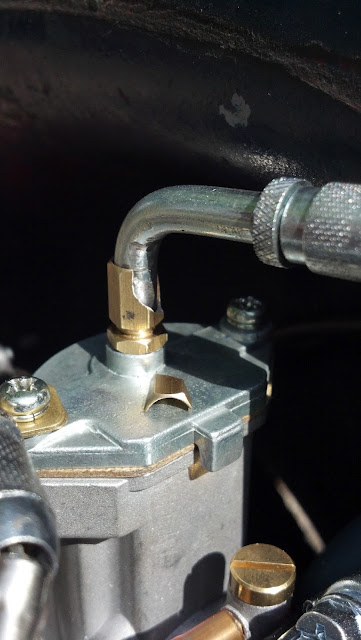
This probably should have been part of the last post about putting in new cable housing but here it is. When I was pulling the slack out of the new throttle cable housing, the tension against this brass fitting on top of the carburetor caused it to break. This should not have happened. It calls into question all of the materials on the whole assembly. I will see if I can find a sturdier replacement as this will most likely fail in the future (although this is a fairly stable connection point) but it's tempting to throw the whole thing out and reinstall the original Del Lorto carburetor.  I am not trying to indict Chinese products on the whole but when your safety at speed depends on the stability of the materials your bike is made of, this sort of failure can be disastrous.